

If we ask a softgunner "What is Airsoft?" he would probably answer "a game that simulates military actions" — and that's basically true. But experienced players will probably find something not quite right about this definition. Why? Let's address some unavoidable questions.
The Four Gaps Between Airsoft and Real Military Simulation
Distances. The power of airsoft guns — though they may vary from country to country — is limited for safety reasons, and that leads to close-range engagements. If you spot your opponents 150 meters from your position, there is little you can do but observe and wait.
Mental state. Airsoft is a game. Have you been hit because you botched something? No problem, mate — do better next time. The reality is that softgunners approach this activity with an entirely different mindset than soldiers on the battlefield. This leads them to assume greater risk, to give less consideration to planning, and to execute with haste and poor accuracy.
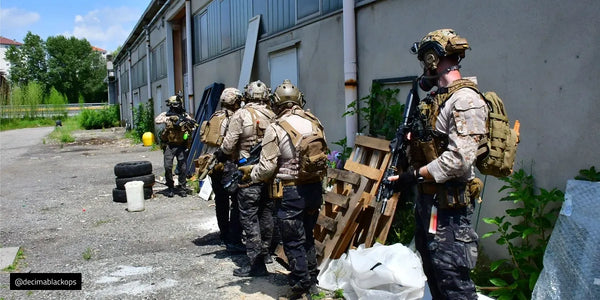
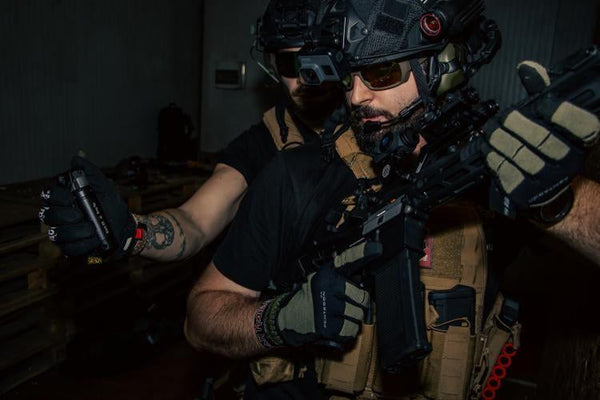
Situational awareness and equipment. The majority of games in airsoft resemble "special operations" due to limited number of players, close distances of engagements, and tight schedule to execute the mission. Here lies one of the major contradictions of this game: real-world special operations run on solid intelligence, aerial support — even limited to overwatch, live feeds, and command & control — and various technological equipment not available to all participants, such as night vision goggles or thermal sensors. Most game formats do not even allow drones for reconnaissance purposes, which would be a reasonable asset considering that no special operator today would willingly operate "in the dark", knowing just approximate numbers and location of enemies. Some rulebooks don't even allow any kind of grenade replicas — which are a valuable aid for assault teams, especially in CQB scenarios where clearing a room without one puts the entry team at a serious disadvantage.
Nature of the gameplay. Most games run on the same patterns: opponents dug in and waiting, Alamo-style, rifles raised ready to receive you. No Live Action Roleplay, no immersion in the scenario they are supposed to be simulating.
What Makes a True MilSim Player Different
Military Simulation enthusiasts are a different breed. They don't want competition for its own sake. They don't care about kill counts. They don't rush to accomplish an objective in less time than other teams for the sake of leaderboards and a pointless trophy.
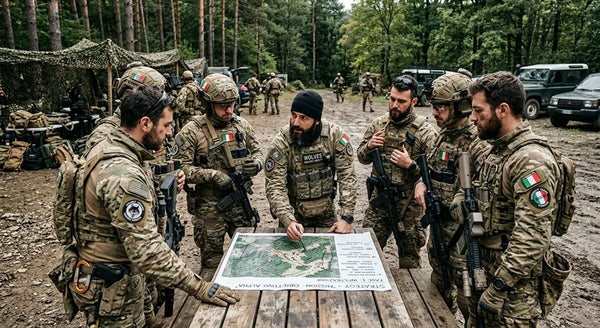
They love to receive a coherent mission with solid background and context — something that feels almost real, something they can genuinely identify with. They want to create their own adventure, apply their TTPs (Tactics, Techniques, Procedures), and think their way through well-constructed objectives, run by opponents who play and act "as if today is no different from yesterday or the day before", as I often say.
How the Defending Side Should Actually Play
This doesn't mean that the defending side has to play passively and without purpose — quite the opposite.
For example: they can conduct irregular patrols of the perimeter instead of being all trenched, leaving just one or two sentinels guarding a key entry point. A regular rotation gives them the chance to simulate a realistic downtime — chat, grab a bite, smoke a cigarette — which, incidentally, is good for breaking the monotony.
If the target is a laboratory where DIREX simulate the processing of narcotics, one or two players should be actively role-playing their job, with their rifle replicas set aside but within reach.
As long as the assault team moves and acts properly without being spotted, the element of surprise is preserved. Otherwise, the defence will shift to a higher level of readiness.
The Alarm Problem — and Why It Matters for CQB Tactics
How alarm is triggered is another aspect worth addressing. It should not go from zero to one hundred in an instant when the situation does not call for it. Especially during night operations or in poor visibility — fog, vegetation — if a defender is uncertain about what he is observing, would it be advisable to open fire without further investigation? In reality, this could lead to serious consequences (friendly fire, or worse).
A challenge — "HALT! IDENTIFY YOURSELF!" — would at least be appropriate.
More immersive, wouldn't you say?
The main idea is: act as it should be — not "I'm defending this objective, I'm bored, I'd like to end this phase as soon as possible so I'm going to give the other side a hard time."
This way of defending broadens the spectrum of tactics available to the assault team, moving beyond the tired move-cover-shoot routine. And it creates the conditions where tools like grenades — used correctly, not randomly — actually change the outcome of an entry rather than being an afterthought. A reliable impact grenade in a proper breach sequence is a TTP, not a gadget. → See how the Brey Tac Blank Kit fits into CQB assault protocol
Stop Calling It MilSim If It Isn't
In the end, it is those who pay for an event who primarily should go home satisfied. Therefore, if the context is "simulative", every effort must be made to ensure that result.
Otherwise, please stop attaching the "milsim" label to every game — only to disappoint the very people you were trying to attract.
Andrea Rossi Founder, Tactical Airsoft Project
We are currently working on an eBook focused entirely on Military Simulation for Airsoft, covering: what a true military simulation is, how to rethink defence for immersive play, how to build a proper storyboard and rulebook, how to construct scenarios, and how to set up and train your team. Publication is expected in 2026 — initially in Italian, with an English version planned if demand warrants it. Follow @_TacticalAirsoftProject on Instagram and let us know if you want the English edition.
2 comments
Hi Ian, thanks for your reply!
I’m the author of the post — I think something got lost in translation, apologies. My intention was to point out that NVGs (especially analog ones) and thermal devices aren’t available to all players due to cost, and that milsim players are only a fraction of the broader airsoft community. The average airsoft player who only attends two or three night games a year will most likely not invest in that kind of equipment — which is why, in Italy at least, such devices remain fairly rare.
P.S. I’ve updated the post to clear up the misunderstanding.
So I noticed you said Night Vision and Thermal devices are not available to players and that is entirely inaccurate. This actually depends on what country you are in and if those devices are legal. I live in the US and am a MilSim player. I also own a set of dual NODs and a true thermal scope, which i use for our similation events frequently.