

The airsoft grenade market has exploded in the last five years. Walk into any serious airsoft loadout conversation and someone will have an opinion about grenades — but most of those opinions are based on outdated information or gear that didn't survive more than a few games.
This guide cuts through the noise. We'll cover every major category of reusable airsoft grenade, what each type is actually good for, and what to look for before you spend your money.
Why Grenades Matter More Than Most Players Think
The majority of casual airsoft players treat grenades as novelty gear — fun to own, rarely used. Serious CQB and milsim players know better.
In Close Quarter Battle scenarios, the first player through a door is at the highest disadvantage. The defender has cover, a prepared position, and the tactical initiative. A grenade — used correctly — shifts that equation. It forces defenders to move, disrupts aim, and creates the split-second window an entry team needs.
That tactical value only exists if the grenade is reliable. A grenade that misfires teaches your opponent that grenades are a bluff. A grenade that fires every time teaches them to respect it.
The Four Types of Reusable Airsoft Grenades
1. CO2 Sound Grenades (Thunder B Style)
The most common type in the US market. Uses a 12g CO2 canister loaded into a plastic shell. Pulling the pin releases CO2 pressure until the shell bursts with a loud pop.
Pros: Widely available, easy to find replacement parts, loud report.
Cons: Plastic shells are single-use, CO2 performance varies with temperature, random pre-detonation risk, higher cost per throw, short delay between pull and detonation can be unpredictable.
Best for: Players who want a proven, easy-to-find system and don't mind the per-throw cost.
2. Blank-Fired Impact Grenades
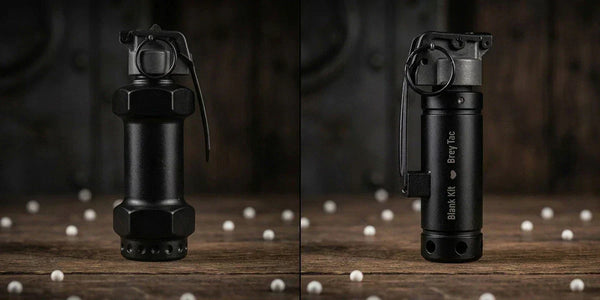
A newer category that replaces CO2 with standard blank cartridges (typically 9mm PAK). The grenade detonates on contact, not on a timer or pressure release. The Brey Tac Blank Kit converts an existing Thunder B into this format.
Pros: Instant detonation on impact, temperature-independent performance, no plastic shrapnel, very low cost per throw (~$0.30), fully reusable aluminum construction, consistent every time.
Cons: Requires sourcing blank cartridges (widely available online and at sporting goods stores), initial conversion investment.
Best for: CQB players who need absolute reliability and use grenades frequently enough that cost per throw matters.
3. Spring/Mechanical BB-Spewing Grenades
Uses a mechanical spring mechanism to launch BBs in multiple directions on detonation. Examples include the Tornado series and similar designs.
Pros: Physically tags opponents within blast radius, satisfying to use in open areas.
Cons: Expensive per unit, can be affected by surface type (fails on soft ground), reload time is significant, disputed effectiveness at CQB distances, often requires specific surface conditions to arm.
Best for: Outdoor milsim with large open areas. Less effective in tight CQB.
4. Gas-Powered BB Grenades
Similar to spring types but uses green gas or CO2 as the propellant. Releases BBs with more force and radius.
Pros: Larger effective radius, more physically realistic effect.
Cons: Most expensive category, heaviest to carry, gas consumption adds up, complex maintenance, effectiveness still depends on surface and deployment angle.
Best for: Dedicated milsim players with a gear budget to match.
What Actually Matters in CQB
If you play primarily CQB — and most US indoor field play is CQB — your grenade requirements are specific:
Instant detonation. A delay between pull and explosion gives defenders time to duck, move, or ignore it. Impact detonation removes that window.
Reliability above 95%. If your grenade fails one in five throws, it becomes a liability, not a tool. Your team will stop trusting it and stop incorporating it into entries.
Portability. CQB kits are already heavy. A grenade that adds significant weight or requires complex carry solutions is one you'll leave in the bag.
Sound, not BBs. In most indoor CQB fields, BB-spewing grenades are either prohibited or ineffective due to wall bouncing and ricochet risk. Sound grenades with a clear bang are field-legal and tactically sufficient.
Cost per use. If every throw costs $2–3, you save grenades for special moments. If every throw costs $0.30, you use them as standard breach protocol.
How to Evaluate Any Reusable Grenade Before You Buy
Check field legality first. Some fields prohibit certain grenade types. Confirm the grenade you're considering is allowed at your primary field before purchasing.
Calculate real cost over a season. Divide the total annual cost (unit + consumables for estimated throws) by throws per game and games per year. The cheapest unit isn't always the cheapest system.
Look for reviews from players at your field type. A grenade that gets glowing reviews from outdoor milsim players might perform completely differently on an indoor CQB course. Filter your research accordingly.
Ask about the failure mode. Every grenade fails sometimes. What happens when it does? A grenade that fails silently (no detonation) is different from one that randomly pre-detonates. Know which failure mode you're accepting.
The Case for the Blank Kit System
For US players who run CQB regularly, the blank-fired impact system has a compelling argument: it eliminates the three biggest failure modes of traditional CO2 grenades simultaneously.
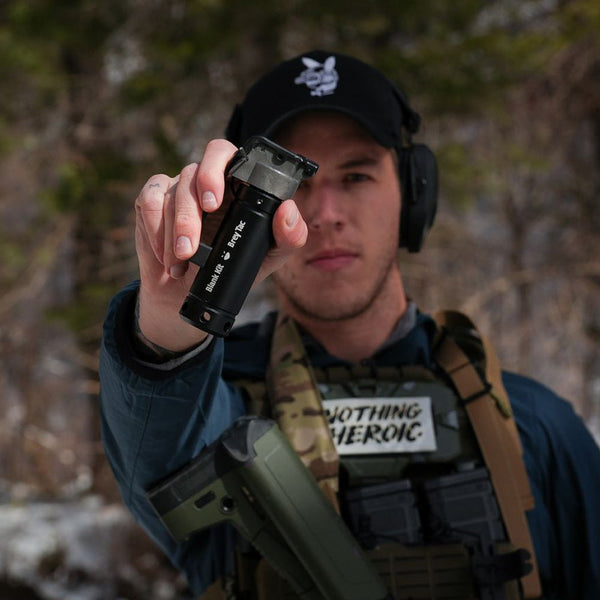
The Brey Tac Blank Kit converts an existing Thunder B — gear most serious players already own — into an impact grenade that fires every time, costs pennies per throw, and requires no plastic shell replacements. The V2 adds improved compatibility, 360-degree sound diffusion, and a redesigned ignition system that's easier to service in the field.
It's not the right choice for every player. If you throw grenades twice a season and already own a Thunder B, the CO2 system works fine for your use case. If grenades are part of your standard breach sequence, the math and reliability argument makes the conversion worth it.
Accessories Worth Considering
A grenade is only as useful as how quickly you can deploy it. Two accessories that most regular grenade users find indispensable:
A dedicated carry system. The Brey Tac Blank Kit Holder mounts to any MOLLE system, holds the grenade securely during movement, and allows a clean one-handed draw. Designed specifically for the Blank Kit but compatible with standard cylindrical grenades.
A cartridge holder. For blank-fired systems, having pre-loaded cartridges staged for fast reload changes your mid-game dynamics. The Brey Tac Cartridge Holder carries 8 shells and keeps two exposed for immediate access, even with gloves on.
The best reusable airsoft grenade is the one you actually trust enough to throw. Reliability, not price point or features, is the deciding factor. Build your grenade kit around that principle and the right choice becomes clear quickly.
See the Brey Tac grenade lineup:
Blank Kit V2 → | Blank Kit Holder → | Cartridge Holder →
0 comments