

Have you ever heard of "unicorns"? Not the white horse with a fancy coloured horn — the phrase we use for things we consider a rare find. Airsoft has its own, and today we will discuss one of the rarest: genuine unit cohesion.
Follow me on this — I promise it will be worth your time.
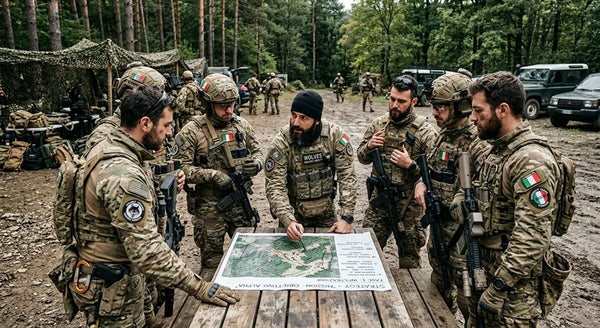
What Makes Milsim Different From Recreational Airsoft
When we talk about military simulation, we know it draws far more heavily from real-world practice than recreational-oriented airsoft does. This requires some specific adjustments, the most important of which concern:
- Equipment. Even if you are not reenacting, accuracy when gearing up is almost mandatory. No casual piece of kit thrown in just to messily patch a gap. Everything must be functional and look the part.
- Rules. The game tends to be more deliberate during planning and execution phases. The pace must be slower, because rushing is detrimental to fully embodying the scenario and making sound decisions. Role-playing is also a key factor in maintaining an immersive environment: poor acting will break focus when it matters most.
- Mindset. There is no approaching military simulation with minimum effort. It is a discipline that demands deeper commitment, so you really have to get your head in the game — otherwise you will always be struggling.
- TTPs. This is the essential point. Teams aiming to play military simulation consistently push for higher levels of Tactics, Techniques and Procedures. The apex of these efforts would be a degree of precision and coordination in movement and action similar to what we often see in promotional videos on social media.
Setting aside professional units — for whom proficiency is simply the job — most of those videos are staged, because genuine unit cohesion is a real unicorn in airsoft, as noted at the outset.
The Real Obstacle Is Time
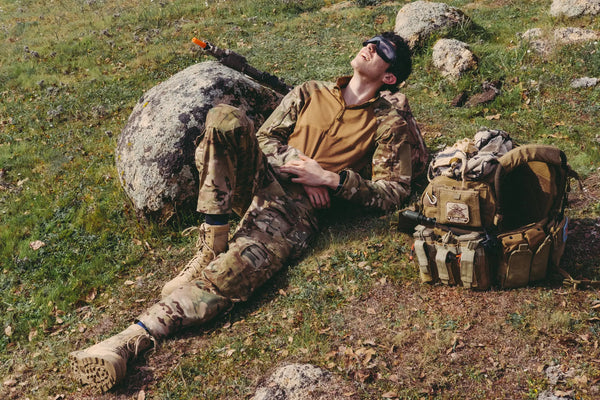
An average airsoft team meets on Sunday for four or five hours — roughly sixteen to twenty hours per month, competitions aside. However, the time softgunners can actually spend in the field is perpetually eroded by obstacles, setbacks, and contingencies, regardless of whatever resolutions teams make at the start of the season.
This is precisely why those who want to improve their game should stop committing their efforts — and their time — to the same routine: drilling just the fundamentals (move, cover, shoot), then death-matching with disjointed injections of TTPs along the way. That is not a recipe for making everyone speak the same language.
A Better Training Framework for Airsoft Teams
Let's take a step back and reconsider what should be done instead:
- Plan an effective training strategy based on the lowest individual level within your team.
- Invest seriously in training phases and demand maximum participation.
- Treat the intra-team Force-on-Force phase as the practical application of prior training.
- Treat friendly matches against other teams, or formal competitions, as the proving ground for what you have developed.
One further suggestion: if possible, avoid introducing new players throughout the season. They will likely dilute the overall level, forcing the group to revisit ground already covered — unless your team roster allows for something such as a "green team".
The Three Building Blocks of Structured Team Training
The foundation of effective intra-team training is a structured path of deliberate steps:
Dry Training
Individual and group movement drills to establish the early neuromuscular patterns essential to building solid muscle memory.
Target Practice
The means by which to develop fluency with replicas and a reliable brain process — the eye-brain-trigger connection — essential for maintaining fire control under the pressure of the game and for discriminating targets effectively (and not shooting at everything that moves).
Dynamic Shooting Courses and Shooting Houses
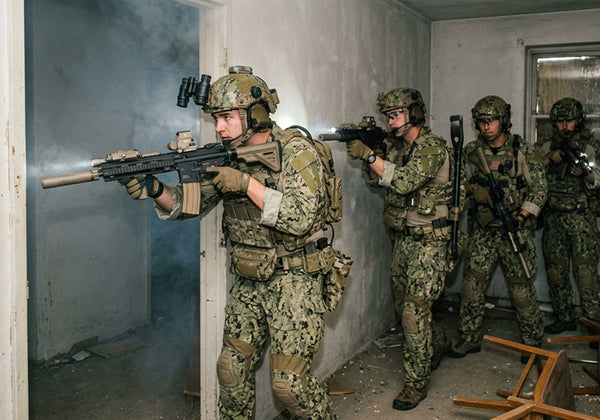
Essential for integrating individual skills within the team, learning to act together as synchronised elements, and building what might be called group memory — an invisible thread of correct habits guiding every member through the right steps. This is also the phase where close-quarter combat fundamentals become second nature rather than something you have to think about mid-entry.
Time-Efficient Training Beats Improvised Training
I know what you are thinking: "To apply these steps we need time — the very thing that is constantly scarce, as you said."
The truth is we cannot expand time, and unless airsoft is your job — or you and your team have plenty of it to spare — genuine unit cohesion will in all likelihood remain a utopia.
But if time is scarce, why spend it doing the same things over and over? Death-matching your way through the season will not bring your team's level beyond a certain mediocre ceiling: an inevitable plateau awaits around the corner. You will probably build solid team bonding along the way, but technical proficiency will not follow proportionally.
Do you want to maximise the outcome of your efforts? Sound training planning is far more time-efficient than an improvised one. This is the same principle that separates recreational airsoft from serious military simulation play — the willingness to plan before you play.
The Tactical Airsoft Project Programme
We at the Tactical Airsoft Project are focusing every effort on building the most time-efficient training programme possible — something that has taken six years of practice to develop and is still evolving.
One manual with fifteen topics explored in depth across 260 pages, and four workouts, each focused on a specific scenario: shooting agility, Close Quarter Combat and Room Clearing, night operations with Night Vision Devices, and woodland environments. Each workout contains a substantial number of exercises — studied, developed and explained in detail — with variants to shift the focus wherever it is most needed.
All you have to do is gear up and get started.
Currently available in Italian, with English versions in active development. In the meantime, you can download the free extracts available exclusively here on the BreyTac store.
See you for the next pill.
Andrea Rossi Founder of 'Tactical Airsoft Project'
Editor's note from Brey Tac
Andrea's framework highlights something we hear often from operators in our own community: reliable, repeatable gear is what makes structured team training possible in the first place. Grenades that don't misfire mid-drill, kit that works when the weather turns, mounts that stay put in a full-stack entry.
If your team's training programme needs equipment that keeps up with the discipline Andrea describes, take a look at the Blank Kit V2 and the Nav-Board.
0 comments