

Close Quarter Battle is where airsoft gets honest.
There's no bush to hide in. No long sightline that rewards a sniper with patience. In CQB, every engagement happens at a distance where mistakes are immediately punished, every corner is a potential ambush, and the player who hesitates is the player who loses.
It's also where the right tactics — and the right gear — make the biggest measurable difference. This guide covers both.
Understanding the CQB Disadvantage Curve
The fundamental dynamic of CQB is asymmetric: the defender almost always starts with the advantage. They have a prepared position, cover, and knowledge of the space. The attacker is moving through an unknown environment with limited information.
This isn't a problem to solve — it's a condition to manage. The entire vocabulary of CQB tactics exists to minimize that defender advantage long enough for the attacker to create their own. Grenades, communication, stacking, and movement timing all serve this single purpose.
Understanding this shapes everything else. When you evaluate a piece of gear or a tactic, the right question is: does this reduce the defender's advantage window?
Core Movement Principles
Slicing the Pie
Before committing to a corner, slice it — move laterally to expose the space on the other side incrementally. Each step reveals more of the room while keeping most of your body protected. The goal is to see before being seen.
Common mistake: rushing the slice. Taking three steps to clear a corner instead of six doubles the chance of exposure. Speed comes from training repetition, not from cutting corners on process.
Fatal Funnel Awareness
The doorway is the most dangerous position in any room entry. It silhouettes you against the frame, limits your movement options, and tells every defender exactly where you'll be for the next half-second.
Move through doorways — don't linger in them. Your entry speed should be calibrated to clear the fatal funnel before a defender can track you. The grenade's job is to create the conditions where that speed is possible.
Button-Hooking vs. Cross-Entry
Two ways to enter a room after a breach:
Button-hook: The entry player hugs the wall immediately adjacent to the doorframe and moves into the near corner. Simple, fast, effective when the room geometry puts the primary threat in the near corners.
Cross-entry: The entry player crosses the doorframe and moves to the far wall. Covers the far corner first, creates more separation from the door, but requires more commitment and speed.
For two-player entries, pairing one button-hook with one cross creates an immediate split that covers both near corners simultaneously — the standard CQB entry for a reason.
Using Grenades Tactically
This is where most players get it wrong. The grenade is not a room-clearing device. It's a distraction and disruption tool — and used correctly, it's one of the most powerful tools in CQB.
What a Grenade Actually Does
A sound grenade in an enclosed space is disorienting. It forces defenders to flinch, turn, or break their sight picture for 0.5–1.5 seconds. In CQB, a second is enormous. An entry executed in the window created by a grenade detonation has a dramatically higher success rate than one executed against a fully alert defender.
This is the tactical logic. You're not trying to eliminate opponents with the grenade. You're buying time for the entry.
Timing the Entry
The entry begins before the grenade lands — not after it detonates.
By the time the grenade is in the air, your stack should already be in motion. The entry player crosses the threshold as the grenade detonates. If you wait to confirm the bang, you've wasted the advantage window.
This requires a grenade that fires predictably. A delayed or unreliable detonation breaks the timing sequence and can actually hurt the entry by announcing your presence without creating the disruption. Impact detonation — where the grenade fires the instant it contacts the floor — is tactically superior to delayed CO2 detonation for this reason. There's nothing to time. You know exactly when the bang happens.
Grenade Placement
Throwing at the center of the room is a beginner move. The goal is to place the grenade where it disrupts the defender's position specifically.
If you've sliced the pie and identified a defender in the far corner, throw toward that corner. Force them to react to something in their position, not something across the room from them.
For rooms with cover (desks, barriers), throw behind the cover if possible. A grenade that lands next to a barrier forces the defender to either move or take the hit without the protection they built their position around.
Gear That Affects CQB Performance
The Grenade System
As covered above — reliability is the deciding factor. A blank-fired impact grenade like the Brey Tac Blank Kit provides the impact detonation timing and consistency that CQB tactics require. At roughly $0.30 per throw, you can afford to integrate it into every entry rather than saving it for "the right moment."
The right moment is every entry.
Carry System
In CQB, you'll need the grenade accessible fast — ideally one-handed, without breaking your ready position with your primary. A MOLLE-mounted holder on your chest rig or plate carrier front panel gives you a consistent draw every time. The Brey Tac Blank Kit Holder is designed specifically for this: open carry, one-handed access, secure enough for prone and crawling movement.
Primary Weapon Length
This isn't a gear buying guide, but it's worth noting: CQB rewards shorter platforms. A longer rifle around corners is a liability. If you're dedicated to CQB, a compact SMG format or a short-barrel AEG with a folding stock gives you a measurable advantage in tight spaces.
Communication
Wired or wireless? For consistent CQB play with a team, wireless is nearly mandatory. Half your tactical communication happens at volumes inappropriate for shouting. Call the breach before it happens, confirm positions, call the clear. Players who can't hear their team lose their team.
Building a CQB Team Protocol
Individual skill matters, but CQB at a higher level is a team sport. A few protocols that separate random groups from effective teams:
Establish a standard stack order. Who breaches first is not a game-by-game decision. Your most aggressive entry player goes first, every time. Consistency beats improvisation.
Pre-brief the grenade call. Who throws, when they throw, and when the entry initiates — this is discussed before the stack moves up. In game, the only communication should be a brief confirmation.
Default entry side. Decide before the event: button-hook left or button-hook right as the default. Reverse on a verbal call. This removes a decision point at the worst possible moment.
Practice dry entries. Before a milsim event, walk the protocol without shooting. Physical muscle memory for the movement sequence means your conscious attention is available for the variables that actually change (room layout, defender positions).
Common CQB Mistakes
Grenade as last resort. Use it first, on the breach. Not when you've already gotten shot twice.
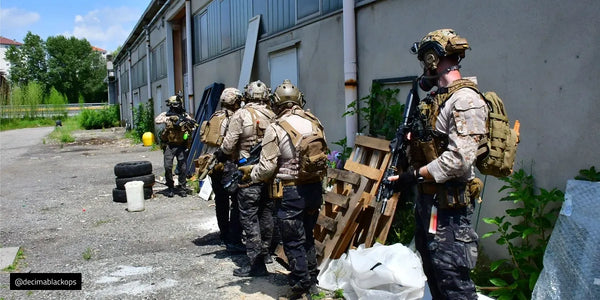
Stacking on the door. The moment you stack on the door in a CQB game, experienced defenders know an entry is coming. Stack back from the door, move up quickly, and commit.
Calling the clear too early. A room isn't clear until every corner and angle is checked. Players who call clear to feel safe create vulnerable moments for their whole team.
Ignoring the upward angle. Indoor fields with elevated positions, balconies, or stairwells create vertical threats. Include vertical in your room scan.
CQB is a skill set. It improves with practice, repetition, and the willingness to debrief what went wrong. The tactics and gear outlined here will accelerate that curve — but the field is where it gets built.
Upgrade your CQB kit:
Blank Kit V2 — impact grenade system →
Blank Kit Holder — MOLLE carry →
0 comments